
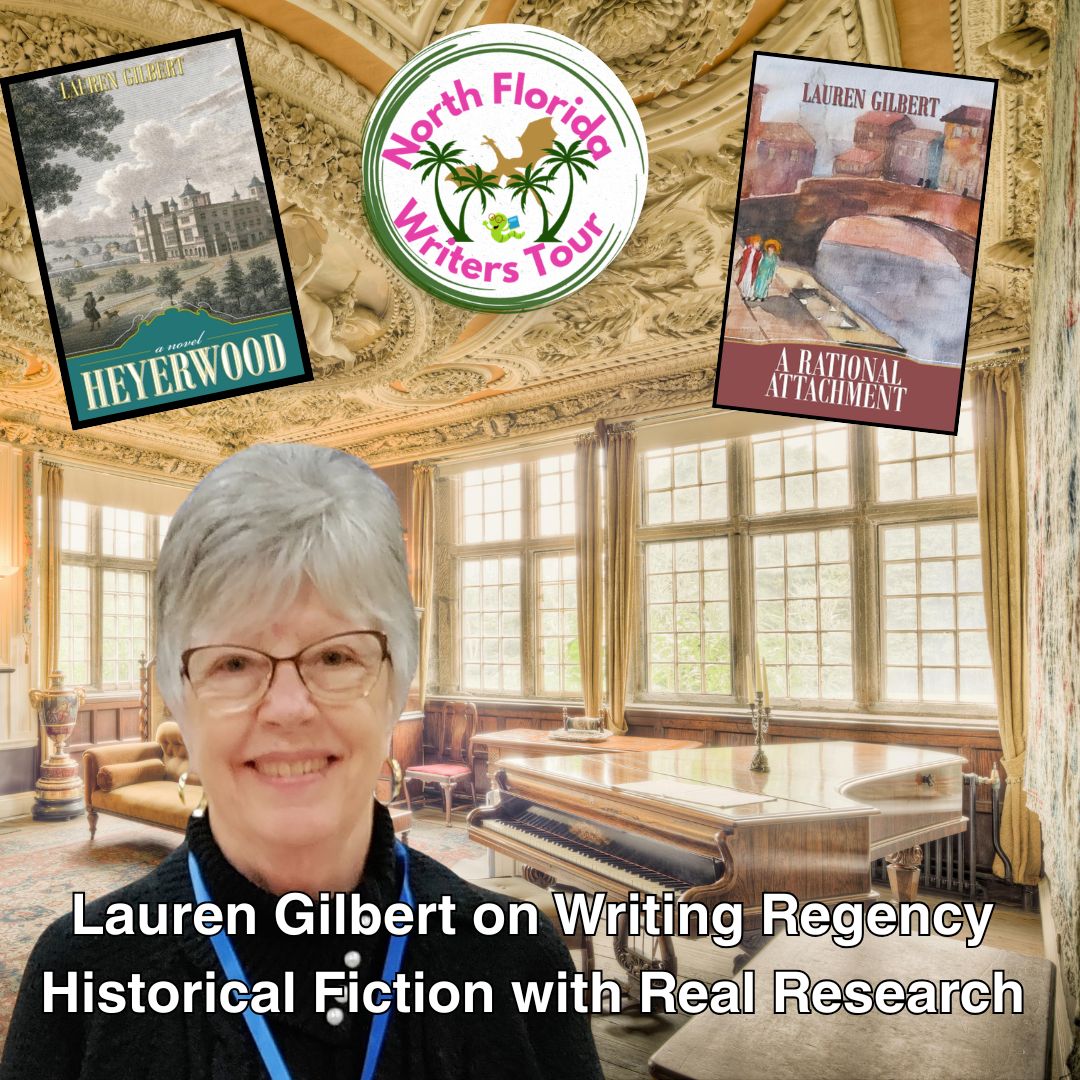
Historical fiction lives or dies by the quality of its research. That’s not just a craft statement; it’s an argument about honesty. Readers who love a period know when something is off, and they know immediately.
Lauren Gilbert, author of Heyerwood and A Rational Attachment, knows this better than most. She has spent years studying the Regency era of Great Britain, holds a Bachelor’s degree in English literature with a minor in art history, and is a member of the Jane Austen Society of North America. She has presented at their Annual General Meeting and served as keynote speaker at the Jane Austen Fest in Mount Dora, Florida, in 2022.
In a recent conversation on Jolene’s Book & Writers Talk, Gilbert walked through the tools, sources, and processes she uses to write fiction grounded in the actual texture of the period.
Start with the Newspapers
Gilbert’s first recommendation for Regency research is the British Newspaper Archive, a subscription service she uses regularly. Period newspapers are primary sources that capture detail no history book can replicate: party guest lists, descriptions of what rooms in a house looked like, what the bride wore, where prominent people were spending their summers.
She is also careful about those sources. Guest lists, she notes, could be wrong: a person listed might have been documented elsewhere as absent. The papers reward close reading but require a critical eye.
Primary Sources: Archives, Genealogy, and Letters
Gilbert supplements newspaper research with genealogical records for tracking marriage, birth, and christening documentation, and wills from the British National Archives, many of which are available online. For her current nonfiction project, she has ordered physical documents that required her to work with 19th-century handwriting, which she describes as a little intimidating.
She also draws heavily on published collections of letters and diaries from Regency contemporaries. Jane Austen’s personal correspondence is a particular resource: Gilbert argues that reading the letters reveals a layer of sharp wit and social observation that Austen’s novels, read alone, can understate.
“Until you’ve read the letters, it’s easy to miss some of the sharp. When you read her letters, you realize there’s a lot of snark here, and she was a normal person.”
The COVID Research Windfall
Gilbert credits the pandemic lockdowns with opening access she might not otherwise have had. During that period, multiple British archives digitized large collections and put them online, often at no charge, to keep their staff working. Gilbert was able to gather significant material on her nonfiction subjects at little or no cost during those two years.
Tracking It All: Spreadsheets in Five-Year Blocks
With a nonfiction project covering seven women, many of whom have thin documented histories, Gilbert developed a research tracking system using spreadsheets organized into five-year time periods. Each entry records the source, date, publication name, and page number, along with any notes she plans to footnote in the final work. Because some of her subjects are documented almost entirely through indirect references, she footnotes extensively so readers can trace every claim.
This approach also caught a detail that mattered: two sources gave different names for the same child. Searching further, Gilbert found the christening record, confirmed the correct name and parentage, and was able to document that the child died at age 14. That kind of granular finding is only possible with a systematic tracking process.
The Nonfiction Project: Seven Women, Little Written
Gilbert’s current focus is a nonfiction work on seven women of power from the Regency era. Some are famous names; four have almost nothing written about them beyond a cardboard cutout mention in novels. Her goal is to recover their full stories.
The project was originally under contract, but the publisher asked for all seven women, well documented, within a year. Gilbert could not do that level of research that quickly without a research budget she does not have. They parted ways, and her editor left the door open for a future submission. She is writing it anyway.
“It’ll be out there one way or another.”
Advice for New Historical Fiction Writers
Gilbert’s three pieces of advice, offered directly in the episode:
- Read as much history of your chosen period as you can find, with a preference for sources written as close to the time as possible.
- Write down every idea as it comes. A notebook dedicated to story ideas means you arrive at your first chapter with material already waiting.
- Remember it is not a competition. Someone not liking your book means they are not your reader. Your readers are out there.
Tools She Recommends
- British Newspaper Archive (subscription) for period newspaper research
- British National Archives online portal for wills and official documents
- FamilySearch.org for genealogical records, free and extensively digitized
- ProWritingAid with its plagiarism scanner, which she uses on both fiction and blog posts
- Google Books, Amazon, eBay, and AbeBooks for sourcing out-of-print research titles
- Project Gutenberg and Archive.org to preview research books before purchasing
Listen to the Full Conversation
Lauren Gilbert’s episode of Jolene’s Book & Writers Talk is available now on YouTube, Apple Podcasts, Spotify, Amazon Music, iHeartRadio, Pandora, and Substack.
Find Lauren Gilbert
Website: https://lauren-gilbert.com/
Facebook: https://www.facebook.com/LaurenGilbert.author
Instagram: https://www.instagram.com/lgilbertauthor/
Bluesky: https://bsky.app/profile/lgilbert1.bsky.social




You must be logged in to post a comment.